

Interview Preparation
Beyond the Resume: How Skill Assessments and Proctored Interviews Work in 2026
Understand how employers evaluate practical skills, identify competency gaps and conduct online assessments, plus how to prepare for each stage.
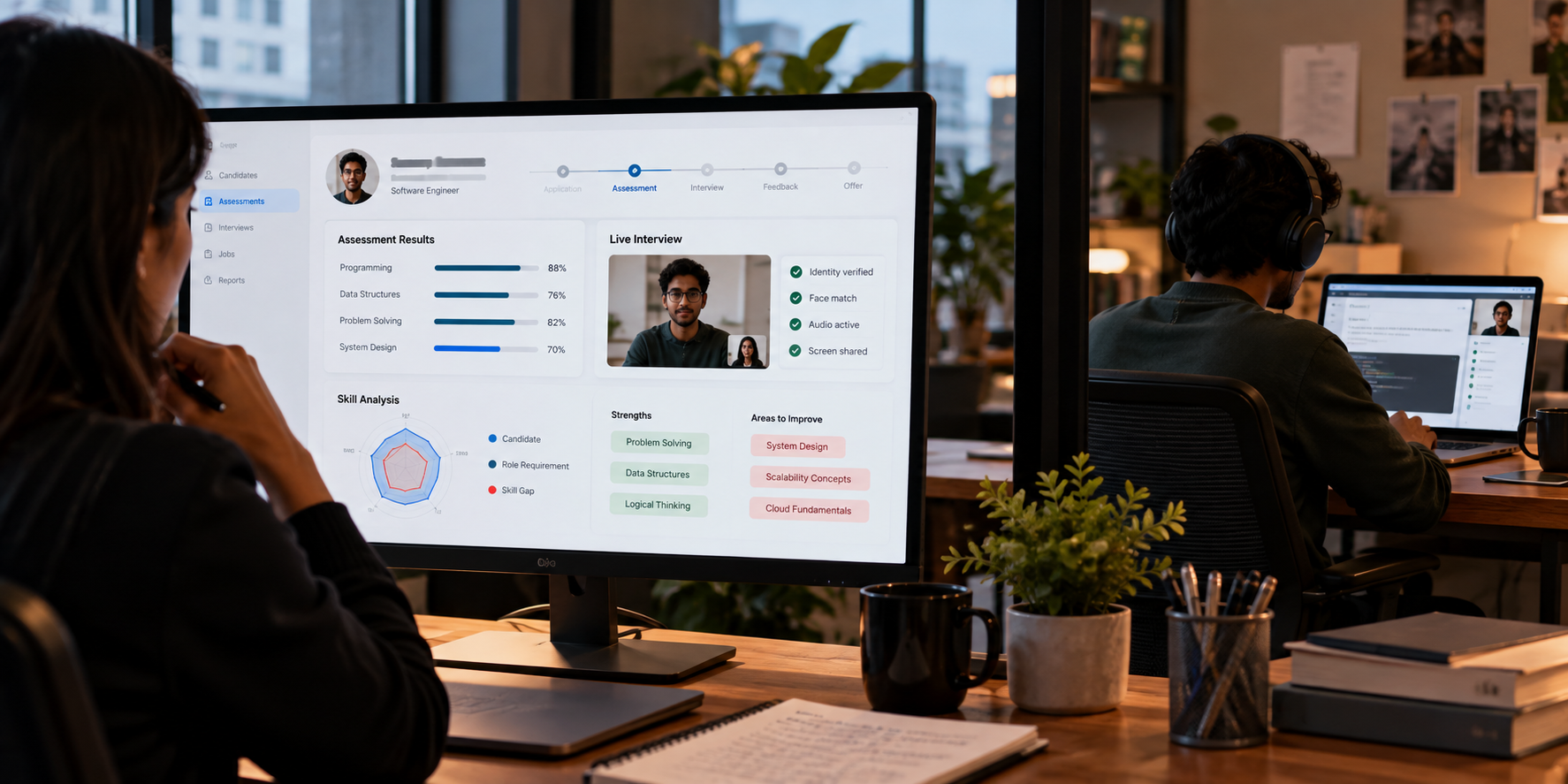
Your Resume Gets You Considered. Your Skills Help Prove Your Fit.
A resume can show where you have worked, what you have studied and which skills you claim to possess. It cannot always establish how well you can apply those skills to a real task.
That is why employers may use technical tests, aptitude assessments, practical assignments and structured interviews alongside resume screening. These methods give hiring teams additional evidence of a candidate’s knowledge, reasoning and ability to handle work relevant to the role.
For candidates, understanding these assessments makes the process easier to navigate. You can prepare more effectively when you know what is being evaluated, how the results may be used and what to expect during a supervised online interview.
1. What Are Pre-Employment Skills Assessments?
A pre-employment skills assessment is a test or exercise used to evaluate abilities relevant to a particular job. The format depends on the position and the competencies the employer needs to assess.
Common assessment types include:
Technical assessments: Coding problems, SQL queries, spreadsheet exercises, debugging tasks and other role-specific tests.
Aptitude tests: Questions involving numerical reasoning, logical reasoning, verbal comprehension or problem-solving.
Work sample tests: Practical exercises that resemble tasks performed in the actual role, such as preparing a sales proposal, analysing a dataset or drafting a customer response.
Situational judgement tests: Workplace scenarios that ask candidates to choose or explain how they would respond to a particular situation.
Communication assessments: Exercises that evaluate how clearly candidates explain ideas, communicate with others or respond to job-related questions.
Not every employer uses every method. A software developer may be asked to solve a coding problem, while a customer support candidate may complete a written response exercise.
The important distinction is that an assessment should measure abilities relevant to the job, rather than test knowledge that has little connection to the work.
2. How Does Candidate Skill Analysis Work?
Skill analysis involves identifying the competencies required for a position and comparing them with the evidence available about a candidate’s abilities.
For example, a data analyst position may require SQL, spreadsheet proficiency, data interpretation and the ability to explain findings to non-technical stakeholders.
An employer could evaluate these requirements through a combination of a technical test, a practical exercise and an interview.
The results may reveal different levels of proficiency across the required skills. A candidate might demonstrate strong SQL knowledge but struggle to explain the business implications of a dataset.
This does not automatically mean the candidate is unsuitable. The importance of each competency depends on the job, and employers must decide how much weight to assign to each result.
What Is a Skill Gap?
A skill gap is the difference between the proficiency required for a role and the proficiency a person currently demonstrates.
For candidates, recognising a skill gap can help identify where further practice or training would be useful.
For employers, this comparison can help distinguish between essential requirements and competencies that could be developed after hiring.
However, an assessment only provides useful evidence when its questions, scoring criteria and difficulty are appropriate for the role. A single test score should not be treated as a complete measure of someone’s professional ability.
3. What Happens During a Proctored Online Interview?
A proctored interview or assessment is conducted under supervision to help establish that the candidate completing the exercise is the intended participant and follows the stated assessment rules.
Depending on the employer and assessment platform, the process may include:
Identity verification before the assessment begins.
Instructions explaining the assessment format, duration and permitted resources.
Video or audio supervision during the session.
Screen sharing or other monitoring, where disclosed and required.
A review of unusual events or potential rule violations.
Follow-up questions to clarify a candidate’s answers or understanding.
These measures are not universal. Some assessments use only identity checks, while others include remote supervision or additional verification steps.
Candidates should read the instructions before beginning and confirm whether calculators, documentation, internet searches, external assistance or AI tools are permitted.
Does Proctoring Guarantee a Fair Assessment?
No. Proctoring can support assessment integrity, but it does not establish that a test is accurate, relevant to the job or fair to every candidate.
Technical interruptions, accessibility needs, unclear instructions and limitations in monitoring systems can affect the assessment experience.
Employers should therefore consider the assessment result alongside other relevant evidence and review potential irregularities in context.
Candidates should also have a clear way to report technical problems, request reasonable accommodations where applicable and seek clarification about the assessment rules.
4. How to Prepare for a Skills Assessment
Preparation should focus on the competencies the employer intends to measure.
Review the job description.
Identify the technical knowledge, tools and responsibilities mentioned in the role. Use these requirements to prioritise your preparation.
Practise tasks related to the actual work.
If the role requires SQL, practise writing queries and interpreting results. If it involves customer support, practise responding to realistic customer scenarios. For analytical roles, work through problems that require you to explain your reasoning.
Understand the test format.
Find out whether the assessment uses multiple-choice questions, practical tasks, written responses or live problem-solving. Check the time limit and permitted resources before starting.
Practise under realistic conditions.
Timed practice can help you manage the available time and identify areas where you need more work. Review incorrect answers rather than simply repeating familiar questions.
Explain your reasoning.
Some assessments include follow-up questions or ask candidates to explain how they reached an answer. Being able to describe your approach can help demonstrate your understanding beyond the final result.
Follow the stated rules.
Use only the resources permitted by the employer. If external assistance or AI tools are prohibited, complete the assessment independently. If the rules are unclear, ask before beginning.
5. How to Prepare for a Proctored Interview
A supervised online interview requires preparation beyond reviewing common interview questions.
Before the session:
Test your internet connection, camera, microphone and browser.
Confirm the interview time, duration and joining instructions.
Keep the required identification document available if requested.
Choose a quiet location with suitable lighting.
Close unrelated applications and notifications if the instructions require it.
Read the monitoring and assessment rules carefully.
During the interview, listen to the complete question before responding. Explain your approach clearly, ask for clarification when necessary and be honest about what you know.
If you experience a technical interruption, inform the interviewer or support contact promptly. Do not assume that an interruption automatically disqualifies you.
Preparation should help you demonstrate your actual abilities, not create the appearance of skills you cannot apply.
6. What Do Assessment Results Actually Tell Employers?
Assessment results provide evidence about performance on particular tasks under particular conditions. They do not necessarily describe every aspect of a candidate’s ability.
A technical test may show whether a candidate can solve a defined problem. A structured interview may explore communication, judgement or previous work experience. A practical assignment may demonstrate how the candidate approaches a task resembling the actual job.
Taken together, these methods can provide a broader view than any single result.
However, assessment scores should be interpreted in relation to the role, the scoring criteria and the conditions under which the test was completed.
A low score may indicate a genuine knowledge gap, but it may also warrant further examination if the instructions were unclear or a technical problem affected performance.
Likewise, a high score on one test does not establish that a candidate will perform well in every aspect of a role.
Employers should use relevant evidence, consistent criteria and appropriate human judgement when making hiring decisions.
7. Can Candidates Ask for Feedback After an Assessment?
Yes. Candidates can ask whether feedback is available, although employers may differ in the level of detail they provide.
A useful request is specific and professional. Instead of asking only why an application was rejected, ask whether the employer can identify the competencies that most influenced the decision or suggest areas for improvement.
If the assessment platform provides a score report, review the categories rather than focusing only on the overall score.
For example, a report may indicate that your technical accuracy was strong while your performance on a particular reasoning task was weaker. If this information is available, it can help direct future practice.
Not every employer will provide individual scores, detailed explanations or personalised skill-gap reports. Candidates should not assume that these services are part of every recruitment process.
8. What Candidates Should Know About Assessment Privacy
Online assessments may involve personal information such as identification details, test responses, recordings or monitoring data. The information collected depends on the assessment and the employer’s procedures.
Before participating, read the relevant privacy notice and assessment instructions. Where appropriate, clarify:
What information will be collected during the assessment.
Whether video, audio or screen activity will be recorded or monitored.
Who can access the assessment results and related data.
How the information will be used and retained.
Whom to contact if you have a privacy concern.
If automated scoring or decision-making is involved, seek information about how the results contribute to the hiring decision.
Privacy rights and employer obligations depend on the applicable law and the circumstances. Do not assume that every platform collects the same information or follows identical retention practices.
Clear communication about assessment requirements and data use helps candidates make informed decisions about participating in the recruitment process.
Make Every Assessment an Opportunity to Demonstrate Your Skills
Hiring assessments are most useful when they give candidates a fair opportunity to demonstrate abilities relevant to the position.
For job seekers, the best preparation is straightforward: understand the role, practise the skills it requires, follow the assessment rules and communicate your reasoning clearly.
For employers, the responsibility is to use relevant assessments, apply consistent criteria and interpret results carefully.
A resume remains an important part of an application, but it is only one source of evidence. Practical tasks, structured interviews and appropriate verification can help employers develop a more complete understanding of a candidate’s capabilities.
If you are exploring your next career move, browse the latest job opportunities on VHire. For more guidance on recruitment, candidate evaluation and hiring practices, visit the VHire blogs.