

Hiring & Recruiting
Hiring Discrepancies in India: What 2026 Verification Data Reveals About Resume Fraud
Most discussion of resume fraud in India runs on anecdotes. Someone knows a candidate who added a year of experience, or a team that found a fabricated degree three months after onboarding. What has been missing is a reliable number.
The Workforce Fraud Files report for H1 FY26, published by AuthBridge on 31 March 2026, provides one. Based on verification checks run across Indian employers, it puts the overall discrepancy rate for white-collar hires at 4.33 percent and for the gig workforce at 6 percent.
That means about one in every twenty-three white-collar hires has something in their file that does not hold up under checking. The figure is lower than the alarm around resume fraud suggests, and higher than most hiring teams assume when they skip verification on senior roles.
Where discrepancies actually appear
The headline rate hides the detail that matters. Failure rates differ sharply by category. For white-collar hires, the verification results break down as follows.
Employment history: 10 percent
Address: 7.7 percent
Education: 4.5 percent
Substance use: 1.9 percent
Court records: 0.5 percent
Employment history is the weak point by a wide margin. Around one in ten employment verifications fails. The report attributes these failures to inflated job titles, incorrect salary figures, dates that do not match the previous employer records, and periods of experience that cannot be confirmed at all.
This runs against where most hiring attention goes. Degree verification receives the scrutiny because a fake degree makes a memorable story. Education discrepancies run at 4.5 percent, less than half the employment rate. The more likely problem in your pipeline is not an invented college. It is a Senior Manager who held a Manager title, or eighteen months of experience recorded as three years.
The sector spread is wider than the national average
A single national figure has limited planning value, because variation between industries is severe.
Retail has the worst employment verification record in the report at 16.67 percent, which is one in six candidates. Education discrepancies run at 9.16 percent, double the white-collar average, and address mismatches at 10.64 percent.
Telecom carries the highest address mismatch rate of any sector at 15.42 percent, along with 14.32 percent employment discrepancies, 7.8 percent education mismatches, and the highest court record rate at 2.3 percent.
BFSI and financial services show 13 percent employment discrepancies and 10.23 percent address mismatches, though education holds up well at 2.93 percent and identity issues stay low at 1.17 percent. Given the regulatory exposure in financial services, a 13 percent employment failure rate is the most consequential number in this report.
Pharma follows closely with 12.1 percent employment discrepancies and 11.21 percent address mismatches, but education mismatches of only 1.75 percent.
IT, BPO and ITES, often assumed to be the centre of resume inflation, performs better than the rest on employment history at 5.26 percent, close to half the white-collar average. Its higher figure is address verification at 12.02 percent, which reflects a mobile workforce more than any attempt to mislead.
Two conclusions follow. If you hire in retail, telecom, BFSI or pharma, the national 4.33 percent figure understates your exposure by a factor of two to three. And a high address mismatch rate is not the same finding as a high employment mismatch rate. One reflects a workforce that relocates frequently. The other reflects a claim that was not accurate.
Gig hiring carries a different risk profile
The 6 percent gig workforce discrepancy rate breaks down differently. Address discrepancies stand at 9.7 percent, identity check failures at 2.5 percent, and court record cases at 2.2 percent.
The identity failure rate deserves more weight than its size suggests. For roles involving home delivery, in-person service, or access to customer premises, an unverified identity is a liability exposure rather than an HR administrative issue. The court record rate of 2.2 percent, more than four times the white-collar figure of 0.5 percent, points in the same direction.
Why these findings arrive too late
The most common discrepancy in this data is also the hardest to catch early. Employment history fails at 10 percent partly because it is the field most applicant tracking systems store as unstructured text, which nobody examines closely until a background check is already running.
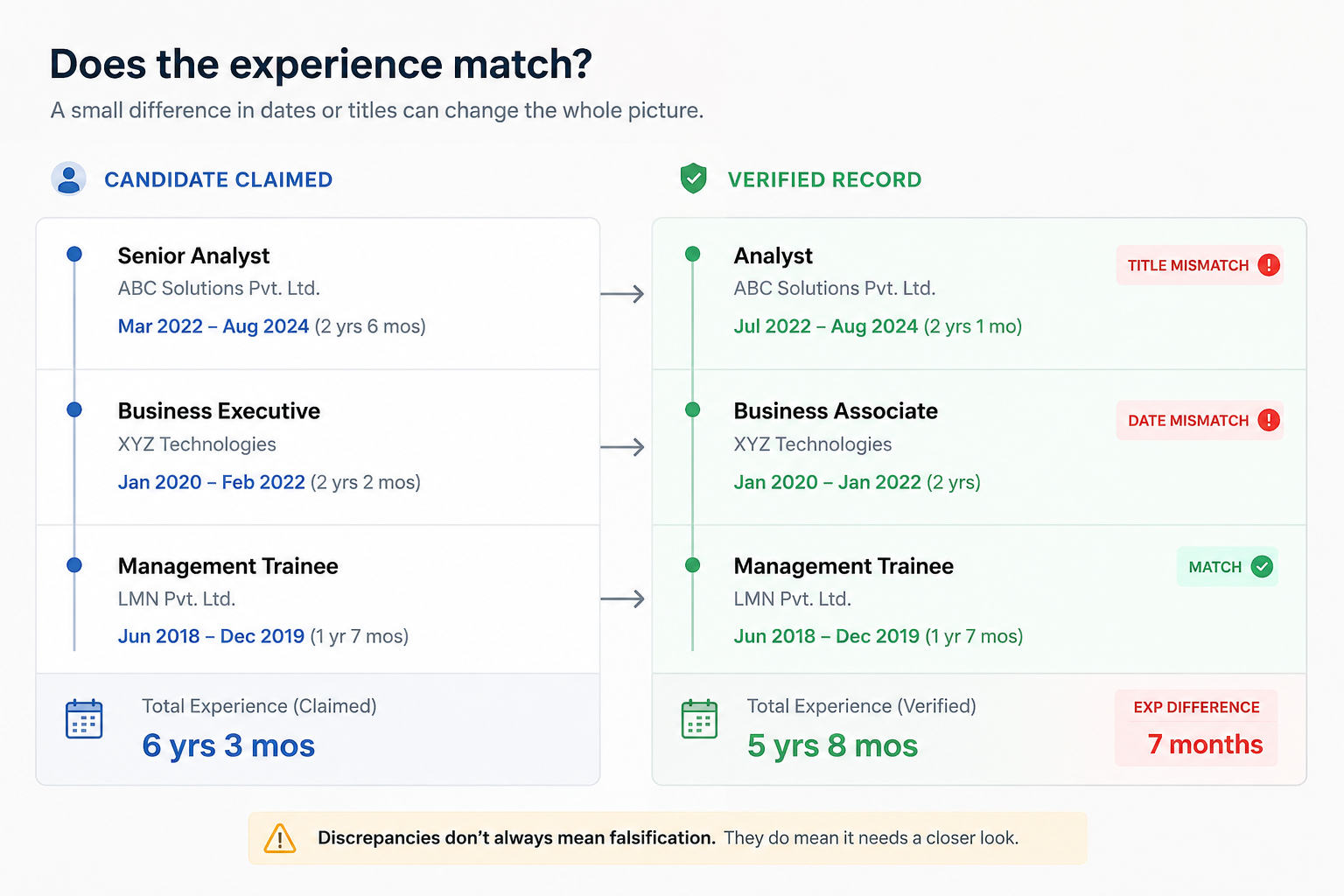
Consider how title inflation survives a full hiring process. A candidate lists Senior Analyst, March 2022 to August 2024. A recruiter reads it, accepts it, and screens the candidate in. Four interview rounds later the candidate has demonstrated they can do the work, because in most cases they largely can. An offer goes out. Verification then returns the actual record: Analyst, July 2022 to August 2024.
At that point the company faces a decision that costs something whichever way it goes, made under time pressure, weeks after the stage where correcting course would have been inexpensive. No individual exercised poor judgement. The information simply arrived in the wrong order.
What VHire changes, and what it does not
An applicant tracking system does not verify anything. VHire is not a background verification provider. It does not contact previous employers, does not access court records, and does not replace AuthBridge or any equivalent agency. Any vendor claiming their software eliminates resume fraud is describing something that does not exist.
What VHire changes is when a discrepancy becomes visible to your team.
Structured capture in place of free text. VHire collects employer name, job title, and start and end dates as separate fields at the point of application rather than as a paragraph inside an uploaded PDF. Structured fields can be compared against each other. A paragraph cannot.
Consistency checks during screening. Because the data is structured, VHire surfaces the contradictions that are detectable before any external check runs. Overlapping employment periods, a stated total experience figure that does not match the sum of listed roles, gaps the candidate has left unexplained, and a claimed title that does not align with the described responsibilities. None of this proves misrepresentation. All of it identifies which files need a closer look, which matters when a role attracts several hundred applications.
Verification triggered by risk, not by seniority. Most teams verify senior hires thoroughly and junior hires lightly. This data suggests a different allocation. If you hire in retail or telecom, volume roles carry the higher failure rate. VHire lets you set screening criteria by role and by function, so a retail store manager pipeline is treated with the scrutiny the numbers justify rather than the scrutiny the salary band implies.
A record you can defend. Every screening decision, note and stage change in VHire is timestamped against the candidate record. When a discrepancy does surface after onboarding, the question that follows is what your process knew and when. A documented trail answers that in minutes.
The value here is not detection. It is sequence. Discrepancies found during screening cost you a shortlist slot. The same discrepancies found after an offer letter cost you a hiring cycle, a candidate relationship, and in regulated sectors, an audit conversation.
What to do with these numbers
Check your own discrepancy rate against the benchmark for your sector rather than the national average. If you do not currently know your rate, that gap is the finding.
Weight employment history verification more heavily than education verification. The data supports it at better than two to one, and most hiring processes are calibrated the other way.
Move your consistency checks earlier. Anything you can detect from the application itself should be caught before the first interview, not after the offer.
If you want the rest of our hiring data coverage, our blog tracks white collar hiring trends, time to hire benchmarks, and the skills employers in India are actually paying for. Read it on our blogs!
If you are hiring right now, live roles from companies using VHire are listed right here. Candidates can apply directly, and every application arrives in a structured format your team can screen against the criteria that matter.