

Hiring & Recruiting
Beyond the Resume: How Employers Are Evaluating Talent in 2026
Why skills, assessments, experience and demonstrated capability are becoming more important in modern hiring
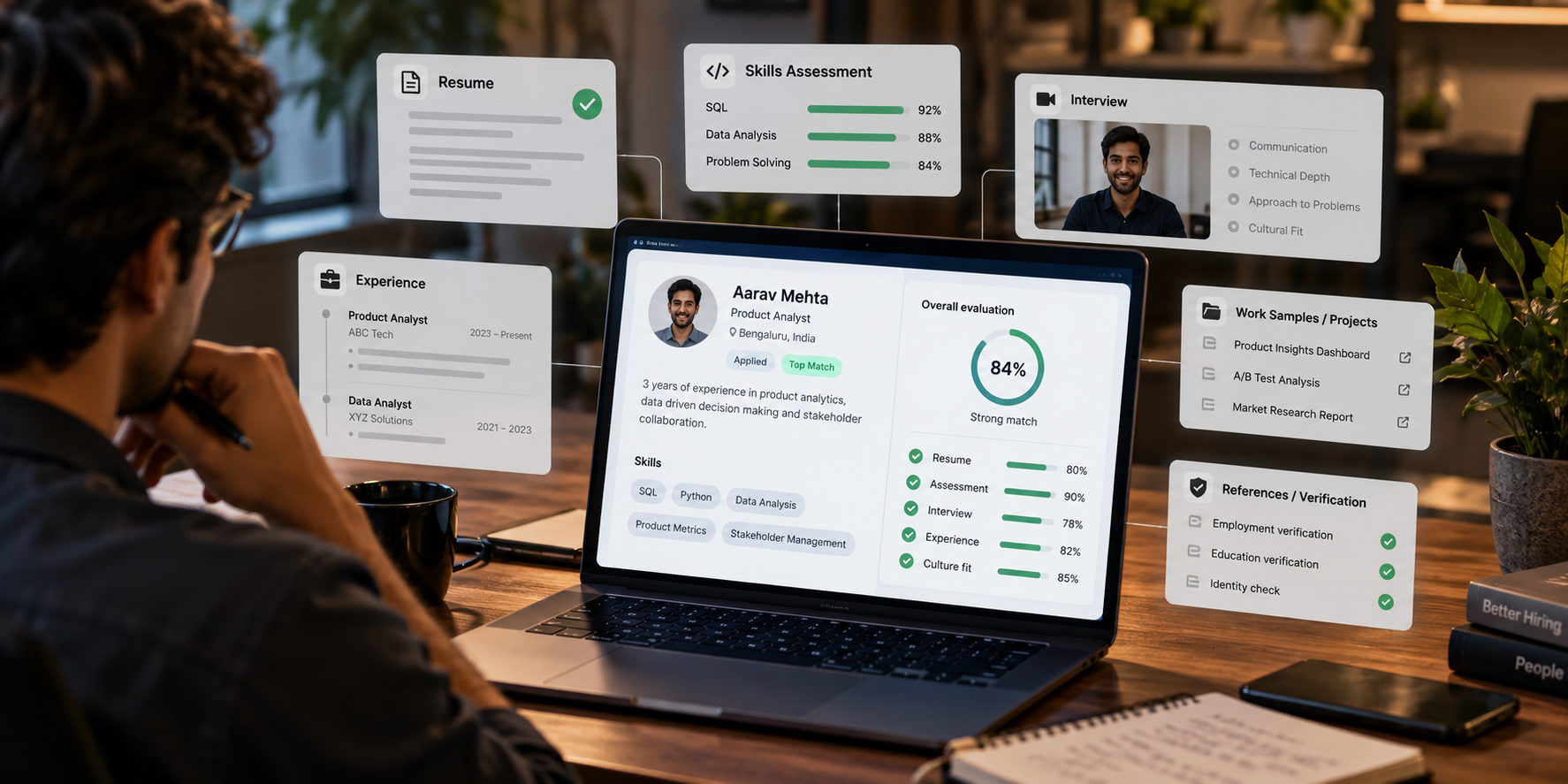
Beyond the Resume: How Employers Are Evaluating Talent in 2026
For years, the resume has been the starting point for almost every hiring decision.
It still is.
But in 2026, it is becoming harder to treat a resume as a complete picture of what a candidate can actually do.
A resume can tell an employer where someone worked, what they studied, which tools they have used and how they describe their experience. What it cannot reliably establish on its own is whether the candidate can apply those skills to the role in front of them.
That distinction is becoming increasingly important as employers move toward more skills-focused hiring.
Deloitte India’s 2026 campus workforce research found that employers are moving beyond degree-based hiring toward skills-led workforce strategies. Its research also found that employers are placing increasing importance on learning agility, adaptability, collaboration and role-specific skills alongside technical capability.
The result is a hiring process where the resume opens the conversation, but increasingly does not finish it.
What a resume does well
A good resume remains extremely useful.
It gives recruiters a fast way to understand a candidate’s background and determine whether there is enough initial relevance to continue the evaluation.
For example, a resume can help answer:
Has the candidate worked in a similar role?
Do they have the required experience?
Have they worked with relevant technologies or processes?
What kind of organisations have they worked with?
Have they delivered projects related to the position?
Does their career history broadly match the role?
This makes the resume an effective screening document.
The problem begins when it is treated as an ability test.
Someone listing Python on a resume does not automatically demonstrate strong Python skills.
Someone listing project management does not necessarily demonstrate strong project management.
Someone claiming experience with data analysis does not necessarily have the analytical ability required for a particular role.
The resume establishes relevance. The rest of the hiring process needs to establish capability.
Why skills are becoming more important in 2026
The labour market is changing quickly enough that traditional proxies for capability are becoming less reliable.
New tools are changing existing roles. Some responsibilities are being automated, while others require combinations of technical, analytical and interpersonal skills that were less important a few years ago.
LinkedIn’s 2026 Skills on the Rise research highlights growing demand across areas including AI and automation, data storytelling, stakeholder management, collaboration and leadership.
Deloitte’s 2026 research similarly found that employers are placing value on both technical skills and human capabilities, with learning agility, adaptability and collaboration becoming important factors in early-career hiring.
This changes the hiring question.
Instead of asking only:
“Does this candidate have the right background?”
Employers increasingly need to ask:
“Can this candidate demonstrate the capabilities this role actually requires?”
From credentials to capability
This does not mean degrees, companies or job titles no longer matter.
They still provide useful context.
The shift is about how much weight each signal receives.
Consider two candidates applying for the same data analyst position.
Candidate A has a relevant degree, two years of experience and several tools listed on their resume.
Candidate B comes from a less conventional academic background but has relevant project experience, performs strongly in a practical assessment and can clearly explain how they approached real data problems.
A resume-led process may favour Candidate A.
A capability-led process has a better opportunity to evaluate both candidates on evidence that is directly relevant to the job.
That is one of the biggest advantages of skills-based hiring.
It can widen the talent pool without lowering the standard.
The assessment is becoming more important
Once a candidate passes initial screening, employers need stronger ways to evaluate what sits behind the resume.
Assessments are one way to do that.
Depending on the role, this could mean:
A coding assessment for an engineering position
A data exercise for an analyst
A writing exercise for a content role
A sales scenario for a business development position
A case study for a product or consulting role
A structured problem-solving exercise for an operations position
The important part is not simply having an assessment.
It is making sure the assessment measures something that actually matters for the job.
A lengthy test that has little connection to the role adds friction without necessarily improving hiring quality.
A focused assessment that tests a genuine job requirement can provide much stronger evidence.
Deloitte’s 2026 research found that AI-based assessments are already used by 48% of surveyed organisations, while resume screening remains the most common AI-supported recruitment use case at 72%.
The direction is clear: screening and assessment are increasingly becoming connected parts of the hiring process rather than isolated steps.
Interviews need to test more than communication
The interview remains one of the most important parts of hiring, but its value depends heavily on how it is structured.
A candidate who interviews well is not necessarily the strongest candidate.
Likewise, someone who is less polished in conversation may have excellent technical or practical ability.
Better interviews therefore connect directly to the requirements identified earlier in the process.
If problem solving is important, test problem solving.
If stakeholder management matters, explore how the candidate has handled difficult stakeholders.
If technical judgement matters, ask the candidate to explain decisions they have made rather than simply asking them to list technologies they know.
This creates a much stronger chain:
Role requirement → Resume evidence → Practical evaluation → Interview evidence → Hiring decision
Each stage answers a different question.
Skills-based hiring does not mean ignoring experience
There is a temptation to interpret skills-first hiring as “degrees do not matter” or “experience does not matter.”
That is too simplistic.
Experience provides context.
A candidate who has spent five years working on similar problems has potentially accumulated knowledge that cannot be replicated through a short assessment.
The better approach is to combine experience with demonstrated capability.
A useful hiring process can consider:
Experience: What has the candidate already done?
Skills: What capabilities does the candidate appear to have?
Assessment: Can they demonstrate those capabilities?
Interview: Can they explain their thinking, decisions and experience?
Role fit: Does the overall evidence match what the organisation actually needs?
The goal is not to remove any one signal.
It is to avoid allowing a single signal to dominate the decision.
What this means for recruiters
For recruitment teams, the shift toward skills-based hiring has a practical consequence.
The hiring workflow itself needs to become more structured.
Job descriptions should distinguish between essential and desirable requirements.
Screening should focus on genuine role requirements rather than arbitrary filters.
Assessments should test relevant capabilities.
Interviews should build on information already gathered rather than starting from scratch.
And recruiters should be able to see the evidence collected across the candidate journey before making a final decision.
This becomes particularly important when hiring at scale.
Foundit expects India’s 2026 hiring environment to remain focused on skills-led and strategic hiring, with demand concentrated in areas such as digital, AI, cloud, data and cybersecurity. Its 2026 outlook also points toward broader hiring beyond India’s traditional metro talent pools.
When the available talent pool becomes broader and more specialised, simply increasing application volume is not enough.
The evaluation process has to become better.
What candidates should take from this
The shift is not only relevant to employers.
Candidates should also rethink how they present themselves.
A resume should not simply list responsibilities.
It should make relevant skills and outcomes easy to understand.
Instead of:
Responsible for managing client accounts.
A stronger version might explain:
Managed 12 enterprise accounts while maintaining 95% retention.
The second statement gives the employer something concrete to evaluate.
Candidates should also expect hiring processes to increasingly include practical assessments, structured interviews and other ways of demonstrating capability.
That is not necessarily a bad thing.
For candidates with strong practical skills but unconventional backgrounds, a better evaluation process can create opportunities that a purely credential-based system might miss.
The resume still matters. It just has less work to do.
The resume is not disappearing.
It is becoming better understood for what it actually is: a concise representation of a candidate’s professional background.
The mistake is expecting it to answer every hiring question.
A strong hiring process goes further.
It identifies what the role requires, finds candidates with relevant backgrounds, tests important capabilities and gives recruiters enough evidence to make a considered decision.
That is where modern recruitment is heading.
The question is no longer simply whether a candidate looks qualified on paper.
It is whether the hiring process gives you enough evidence to know they can actually do the job.For candidates, the next step is to see what opportunities match their skills, while recruiters can continue exploring practical hiring insights across our Jobs and Blog pages.